
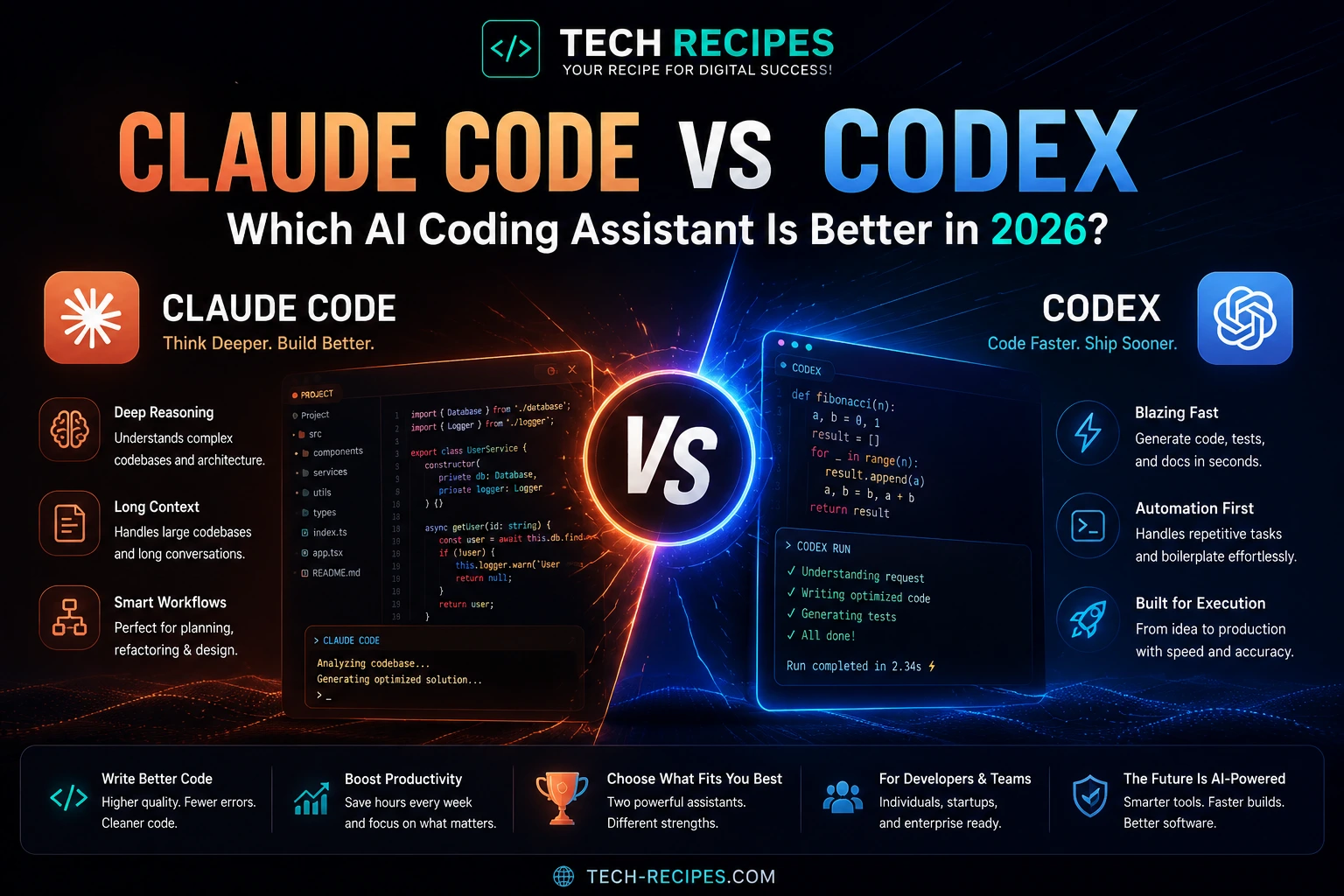
Claude Code vs Codex: Which AI Coding Assistant Is Better in 2026?
AI coding assistants are evolving rapidly, and two of the most advanced tools in 2026 are Claude Code and OpenAI Codex.
Both platforms help developers generate code, debug applications, refactor projects, and accelerate software development workflows using AI.
However, they approach development very differently.
In this comparison, we tested Claude Code vs Codex based on:
- Code quality
- Reasoning ability
- Autonomous coding workflows
- Developer experience
- Performance
- Pricing
- Best use cases
Quick Verdict
| Tool | Best For | Verdict |
|---|---|---|
| Claude Code | Reasoning & large codebases | Best for deep engineering workflows |
| OpenAI Codex | Autonomous execution & speed | Best for fast production workflows |
Claude Code is generally stronger for debugging, architecture analysis, and long-context reasoning.
Codex is stronger for autonomous task execution, rapid generation, and production-oriented workflows.
What is Claude Code?
Claude Code is Anthropic’s AI coding assistant focused on deep reasoning, long-context understanding, and collaborative coding workflows.
It is especially popular among developers working on large codebases and architecture-heavy projects.
Key Features
- Large context windows
- Strong reasoning capabilities
- Codebase understanding
- Debugging assistance
- Refactoring workflows
- Terminal-first workflows
What is OpenAI Codex?
OpenAI Codex is an AI coding platform designed for autonomous coding workflows, rapid task execution, and cloud-based development assistance.
Codex has expanded significantly in 2026 with desktop, CLI, and mobile integrations. :contentReference[oaicite:0]{index=0}
Key Features
- Autonomous coding agents
- Cloud sandbox execution
- Parallel task workflows
- Fast code generation
- Multi-agent workflows
- ChatGPT ecosystem integration
Claude Code vs Codex: Feature Comparison
| Feature | Claude Code | OpenAI Codex |
|---|---|---|
| Reasoning quality | Excellent | Very Good |
| Autonomous execution | Moderate | Excellent |
| Long-context understanding | Excellent | Strong |
| Speed | Good | Excellent |
| Codebase analysis | Excellent | Very Good |
| Cloud execution | No | Yes |
| Terminal workflows | Excellent | Strong |
Reasoning & Code Quality
Claude Code
Claude Code is widely considered one of the strongest AI coding tools for deep reasoning and architecture-heavy workflows.
It performs especially well when debugging complex systems, reviewing codebases, and understanding large project structures. :contentReference[oaicite:1]{index=1}
Many developers prefer Claude Code for collaborative engineering workflows because it behaves more like a senior pair programmer.
OpenAI Codex
Codex focuses more heavily on rapid execution and autonomous task completion.
It can generate production-ready code quickly and perform multiple coding tasks in parallel using cloud-based workflows. :contentReference[oaicite:2]{index=2}
Codex is often faster than Claude Code for straightforward implementation tasks.
Developer Experience
Claude Code
Claude Code feels highly collaborative and conversational.
It tends to ask clarifying questions, explain reasoning, and guide developers through architecture and debugging workflows. :contentReference[oaicite:3]{index=3}
This makes it attractive for developers working on complex systems or exploratory engineering tasks.
OpenAI Codex
Codex feels more autonomous and execution-focused.
It is optimized around fast implementation, async workflows, and cloud-based coding agents. :contentReference[oaicite:4]{index=4}
Developers already inside the ChatGPT ecosystem may find Codex especially convenient.
Performance & Speed
Codex generally performs faster for autonomous coding tasks and production-oriented workflows. :contentReference[oaicite:5]{index=5}
Claude Code prioritizes reasoning depth and context quality over raw execution speed.
This creates a tradeoff:
- Claude Code → deeper reasoning
- Codex → faster execution
Cloud vs Local Workflows
Claude Code
Claude Code typically works directly with local environments and terminal workflows.
This is attractive for developers who prefer working closely with local files and infrastructure. :contentReference[oaicite:6]{index=6}
OpenAI Codex
Codex uses cloud-based execution environments and autonomous agents.
This allows it to run coding tasks asynchronously and manage workflows without depending entirely on local systems. :contentReference[oaicite:7]{index=7}
Benchmarks & Real-World Results
Independent comparisons suggest both tools perform at a very high level, but they excel in different areas.
Some benchmark studies show Codex leading in terminal and production-oriented tasks, while Claude Code performs strongly in reasoning-heavy workflows and documentation quality. :contentReference[oaicite:8]{index=8}
Many advanced developers now use both tools together depending on the task type. :contentReference[oaicite:9]{index=9}
Which Tool is Better for Beginners?
Codex is generally easier for beginners already using ChatGPT because of its ecosystem integration and autonomous workflows.
Claude Code has a steeper learning curve but rewards developers who want deeper engineering workflows.
Which Tool is Better for Professional Developers?
Professional developers working on complex systems may prefer Claude Code for debugging, architecture analysis, and deep context reasoning.
Developers focused on rapid implementation and production workflows may prefer Codex.
Best Use Cases
Choose Claude Code If:
- You work on large codebases
- You need deep reasoning
- You prioritize debugging workflows
- You prefer collaborative AI interaction
- You work heavily in terminal environments
Choose Codex If:
- You want autonomous coding agents
- You prioritize speed
- You need cloud execution workflows
- You use the ChatGPT ecosystem heavily
- You want rapid production implementation
Are AI Coding Assistants Replacing Developers?
No. AI coding assistants dramatically improve productivity, but developers still need to validate architecture, review generated code, handle security, and manage real-world engineering tradeoffs.
Recent research also highlights reliability and reproducibility challenges in AI-generated code workflows. :contentReference[oaicite:10]{index=10}
Final Verdict
Claude Code and OpenAI Codex are currently two of the most advanced AI coding platforms in 2026.
Claude Code is generally the stronger option for reasoning-heavy engineering workflows, debugging, and large-scale code understanding.
OpenAI Codex is the stronger platform for autonomous execution, rapid implementation, and cloud-based development workflows.
For many advanced developers, the best workflow may actually involve using both tools strategically depending on the project and task type.